A Perfect Day in Bellingham: Waterfalls, History & a Very Happy Dog
There are places that feel like they've been waiting for you. Bellingham, tucked into the North Tyne valley in Northumberland, is one of them — and on a morning when the light was doing something remarkable over the fells, my dog Billy and I set off to discover just how much this little market town could pack into a single day.
The Hareshaw Linn Trail: Billy's Finest Hour
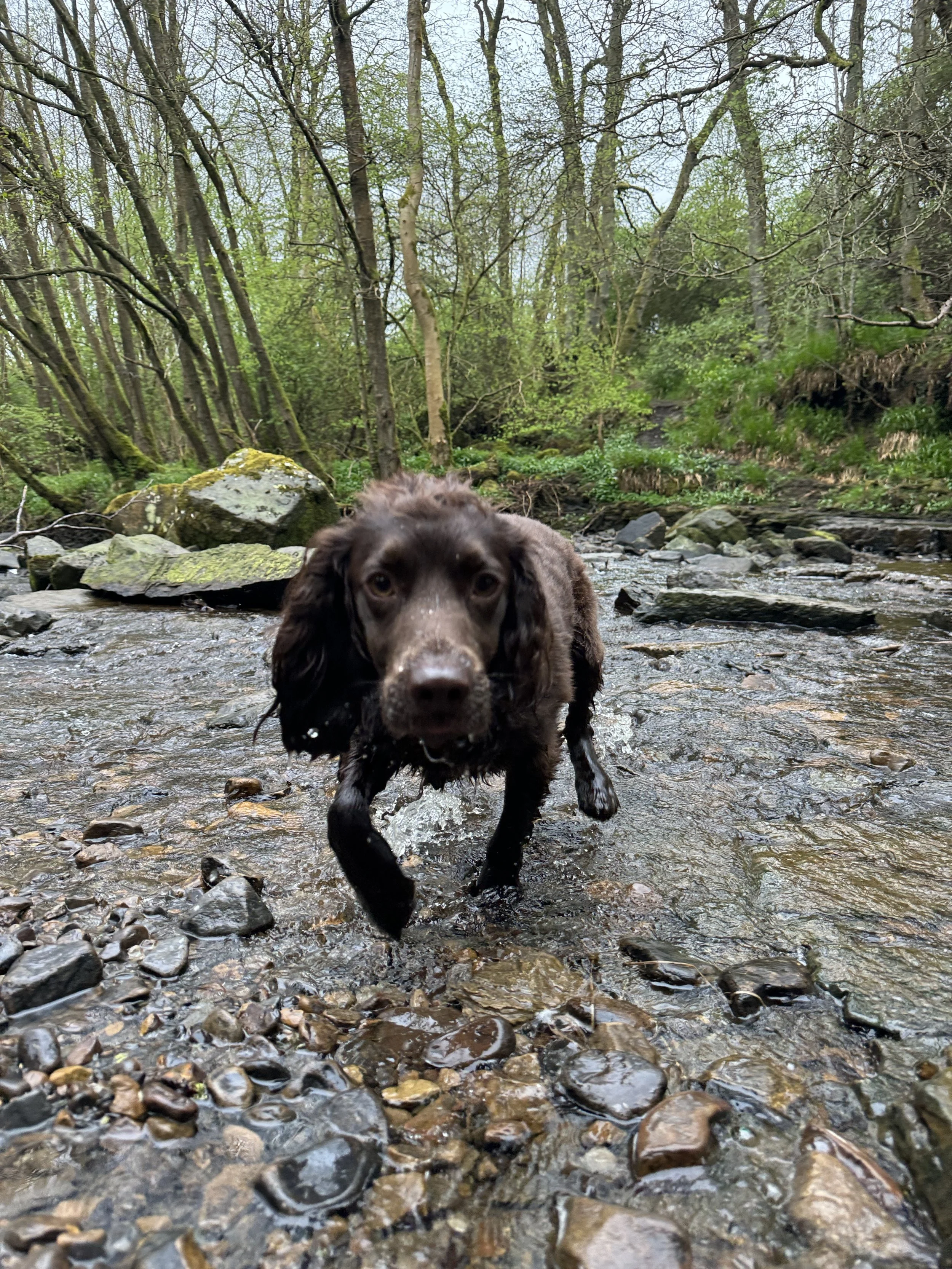
Billy knew before I did. The moment we crossed the footbridge at the edge of town and the path curved into the gorge, his nose dropped to the ground and his tail became a blur. The walk to Hareshaw Linn is barely two miles, but it earns every step — the path winds along Hareshaw Burn through ancient sessile oak woodland, crossing and recrossing the stream on a series of wooden footbridges that Billy treated with deep personal suspicion until he didn't.
Six bridges in all, and the woodland closes in around you as you climb, the canopy thickening, the sound of water growing louder. Then the valley narrows to a rocky chasm and there it is: a thirty-foot curtain of water dropping into a dark pool, the rock face glistening, spray catching what little light filters through the trees above.
We stood there a while and contemplated a dip in the plunge pool, but it was too cold for even Billy to seriously consider.
We didn’t think the walk back could be any better than the way out but it was, mainly due to us spotting 3 deers up high above us in the mountainous woodland.
The Railway Museum: Smaller Than Expected, Better Than Expected
The North Tyne Railway Visitor Museum sits quietly near the old station site — a reminder that Bellingham was once connected to the wider world by the Border Counties Railway, a line that ran through some of the most spectacular and unforgiving landscape in England before closing in 1956. The museum is a labour of love rather than a grand institution, but that's exactly what makes it worth an hour of your time.
Photographs of the old stations, maps of a route that climbed through Redesdale and on towards Riccarton Junction — a station so remote it had its own school and could only be reached by train. Billy waited outside, attached to a fence, wearing the expression of a dog who has been left outside shops many times and has developed opinions about it.
Tea on the Train: Coffee Worth the Name
Next door to the museum, Tea on the Train does exactly what it says as the café occupies a converted railway carriage. I had a lovely coffee and a slice of something with too much icing on it and felt no guilt whatsoever. Billy was given water in a bowl by someone who clearly understood dogs, and he sat under the table in the manner of a dog who is absolutely fine, actually, and not at all watching the cake counter.
Along the River and Up to Brown Rigg
From Bellingham, a footpath follows the North Tyne south — wide skies, the river running below, the valley stretching out in that particular Northumbrian way that makes you feel small in the best sense. Billy ranged ahead and behind, investigating everything, reporting back on nothing.
We climbed away from the river toward the site of Brown Rigg, the old boarding school that once stood out here on the edge of the moors. Now converted in holiday homes, I thought about the children who once boarded here, miles from home, and what they made of these hills in winter.
A Stretch of the Pennine Way
From Brown Rigg we picked up a section of the Pennine Way heading briefly north — that long spine of England running from Edale to Kirk Yetholm, worn smooth by decades of boots. Even a mile or two of it has a different quality to other walking, as if the path itself carries a kind of weight. Billy, for his part, was indifferent to the historical significance and focused on a rabbit he had absolutely no chance of catching.
We turned back toward Bellingham as the afternoon began to soften. The town appeared below us, compact and stone-built, the church tower marking the centre, and smoke rising up from the chimney pots.
The First and Last Brewery: Where the Day Found Its Ending
The First and Last Brewery was doing something right. By early evening, a small crowd had gathered on the outside area — not a crush, but the comfortable density of a place where people have decided, collectively, that this is where they want to be. A band was setting up in the corner, the kind of local musicians who know how to read a crowd and have songs for every mood. Street food vendors were doing brisk business: something with pulled pork, something with halloumi, someone selling brownies from a tin.
I had a pint of whatever they'd brewed locally and it was exactly correct — hoppy without being aggressive, cold without being unkind. Billy lay under the table with his chin on his paws, watching the evening with the satisfaction of a dog who has covered ground and drunk from streams and been given water in a bowl by a kind stranger.
The band played as the sun moved behind the western fells. The light went gold, then amber, then that particular Northumberland shade of almost-dark that lingers long past when it should.
I didn't want it to end. That's the thing about a day like this — it doesn't ask anything of you except to be present for it.
Bellingham: smaller than you'd expect, better than you'd hope. Billy gives it five stars. So do I.